the short version
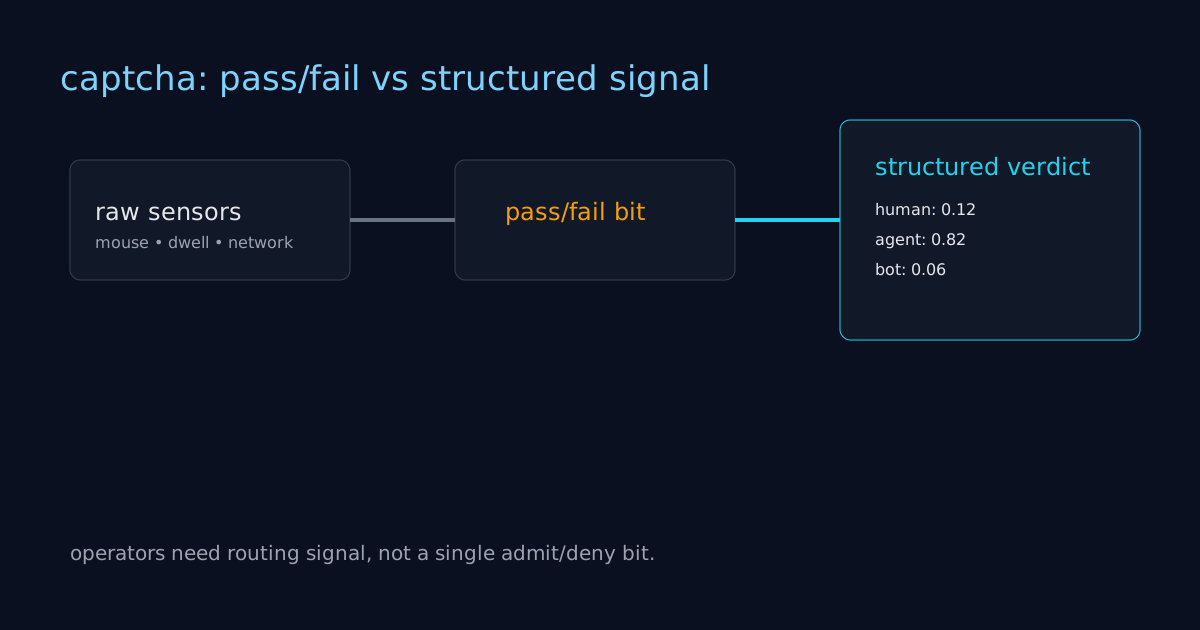
A captcha that returns only pass/fail throws away most of what its sensors saw. The page knows whether the visitor moved a mouse, scrolled, dwelled, copy-pasted, switched tabs, and how the request was constructed at the network layer. Collapsing all of that into one bit means the operator can't tell a confused human apart from a low-effort scraper apart from a legitimate agent — they all show up as "fail."
A signal-producing gate keeps the structure. It emits a compact JSON object that says who you probably are (human / agent-on-behalf-of-human / autonomous bot), how confident the gate is, and which signals fired. Then the operator gets to route, not just admit or reject.
why pass/fail is a category error
Pass/fail made sense when the only meaningful population was "human vs. scraper." That world is gone. Three populations now matter:
| Population | Example | What the operator usually wants |
|---|---|---|
| Humans | A person signing up for the product | admit, log normally |
| Authorized agents | ChatGPT browsing on a paying user's behalf | admit, tag as agent, throttle, no MFA loop |
| Autonomous bots | Credential stuffer, scraper, spam farm | deny or honeypot |
Pass/fail can't tell the second from the third. So operators do one of two bad things:
- Block everything that fails the captcha. This means real users who fail a click-the-traffic-lights challenge are bounced, and legitimate AI agents (which often will fail a vision-based challenge) are bounced too — even when the human behind them has paid for the privilege.
- Lower the gate. This admits the legitimate agents but also admits the scrapers, because the gate has no way to distinguish them.
Neither is what the operator actually wants. They want routing, not gatekeeping.
what a signal-producing gate actually emits
{
  "verdict": "agent_authorized",
  "confidence": 0.87,
  "population": {
    "human_likelihood": 0.04,
    "agent_likelihood": 0.91,
    "bot_likelihood": 0.05
  },
  "signals": {
    "interaction": { "mouse_path": "none", "scroll": false, "dwell_ms": 240 },
    "network": { "asn_class": "datacenter", "tls_fingerprint": "browser-like" },
    "agent_provenance": { "header_present": true, "signature_valid": true }
  },
  "advisory": "treat as authorized agent — skip captcha challenge, apply rate limit tier 2"
}
The operator can now:
- admit humans normally
- admit authorized agents with a different rate-limit tier and no email-verification loop
- challenge or deny the bot population
- review the borderline confidence cases in a triage UI instead of guessing
what changes for the user
For humans: nothing visible. The gate is invisible most of the time. When a challenge is needed, it's the same kind of friction they're used to.
For agents acting on behalf of a paid user: the agent presents a signed token (or operates from a known agent IP range, or sets an agent-identification header), the gate sees the signal, and the agent passes without a vision-puzzle they were never going to solve.
For bots: the same friction as before, plus the operator can now feed the verdict into rate-limit and fraud systems with richer data.
the operator side of the change
The hard part isn't the gate itself — it's persuading operators that "give us signal, we'll do the routing" is a better contract than "give us a yes/no." Three things make this concrete:
- Verdict + confidence in the response. Operators can pick a confidence threshold per route. Login pages might want 0.95+, comment forms might be fine at 0.6.
- Per-signal breakdown. When something fires unexpectedly, the operator can see which sensor disagreed with the verdict and tune.
- Audit log. Every verdict is replayable — same request, same signals, same decision — which matters when an operator has to explain to a customer why their signup was challenged.
frequently asked questions
isn't this just a captcha with more telemetry?
No. The point isn't more data — it's that the data leaves the gate in a useful shape. A traditional captcha collects similar telemetry internally and then throws away the structure before returning a single bit. Signal-producing gates return the structure.
what about privacy?
The signal is about request shape, not identity. No biometrics, no tracking-grade fingerprinting, no PII. The operator gets the same population guess they'd get from a captcha — just with the reasoning attached.
how does this handle adversarial agents pretending to be authorized?
That's the agent provenance signal's job — signed tokens, known agent endpoints, and behavioral verification. An unauthorized agent claiming to be ChatGPT will fail the signature check and drop into the bot bucket.
does it work with existing captcha integrations?
The response is a superset of pass/fail, so operators that only care about the verdict can ignore the structured signal. The structured signal is there when they want to upgrade their routing.
takeaway
Captcha that returns one bit was built for a world where the only meaningful threat was "is this a human." The threat surface has changed. The gate needs to give operators enough information to route, not just admit. That's what panel does.
panel is a signal-producing gate for captcha and agent traffic. read how it works or try the gate demo.